Hiking near Agadir is one of the easiest ways to understand why this part of Morocco feels so distinctive. The city itself sits between the Atlantic and foothills of the surrounding mountains, so you do not have to travel far before the urban shoreline gives way to argan country, rocky valleys, dry hills, and greener pockets shaped by seasonal water. The result is a beautiful hiking region that is not defined by one single famous mountain, but variety.
Hiking Near Agadir
With Morocco Hike Tours, a walk around Agadir can mean climbing to a historic viewpoint above the bay, following a palm-lined gorge toward natural pools, or exploring protected coastal landscapes south of the city where dunes, cliffs, and birdlife become part of the experience. The wider Souss-Massa region is promoted precisely for that mix of coast, nature, and mountain scenery, and it is this contrast that makes hiking near Agadir so rewarding.
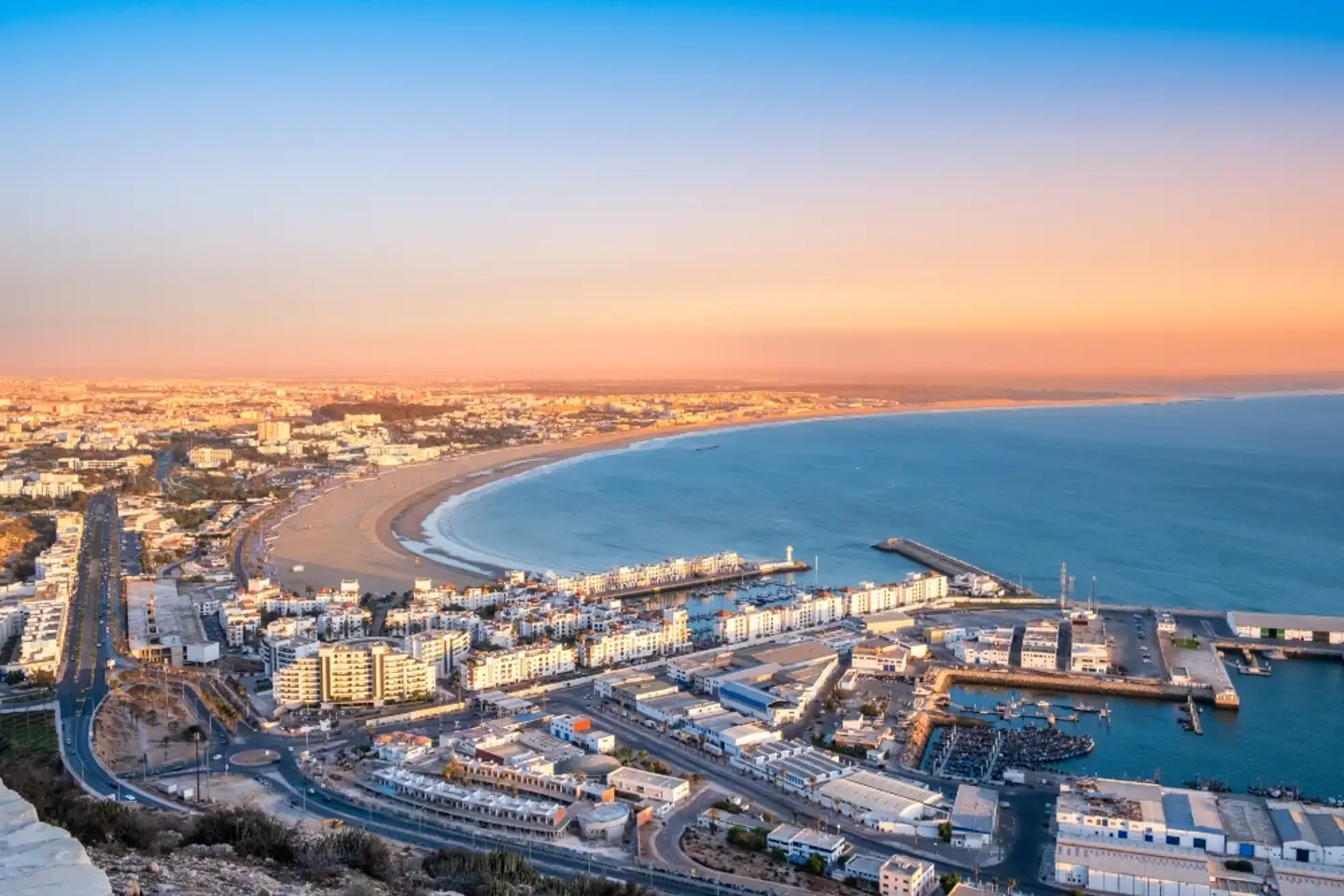
For many visitors, the gentlest hiking near Agadir is the hike to Oufella, the old fortress overlooking the city. This is not a wilderness trek, but it is still a satisfying one because it combines effort, history, and immediate payoff. The official site for the fortress notes a dedicated hiking trail of 2.8 kilometers from the city side, and once you gain height the entire curve of Agadir Bay opens below you. It is the kind of route that works well for people who want a short outing rather than a full day in the mountains.
The setting matters as much as the physical effort about hiking near Agadir. From top, the city appears framed by sea on one side and the dry inland relief on the other, which helps you grasp the geography that shapes all the longer hikes in the region. Since the fortress reopened to visitors in 2024 and is open daily with set visiting hours, it has become an even more practical option for travelers who want a structured, accessible walk close to town.
The most talked-about hiking near Agadir is Paradise Valley, in the Ida-Outanane mountain area north of the city. It is part of the valley of the Tamraght River in the foothills of the Western High Atlas, roughly north of Agadir and reachable in less than an hour. The appeal is easy to understand. The valley is known for its natural pools, palm trees, rocky walls, and a route that feels more like moving through an oasis corridor than climbing a peak.
This is one of the reasons Paradise Valley suits such a wide range of walkers seeking hiking near Agadir. You are not going there for alpine drama or extreme altitude, but a landscape that changes gradually as you move deeper into it, with water, shade, stone, and vegetation constantly shifting the mood of the walk. What makes Paradise Valley especially attractive is that it offers both movement and pause. A hike there is rarely just about distance.
Many people walk in, stop at viewpoints or pools, sit in the shade, and continue at an unhurried pace. That rhythm fits the climate and the landscape. In a region where the light can be strong and the ground often dry, the presence of water and palms changes the feel of the day completely. The valley has long been marketed as one of the most pleasant natural excursions for hiking near Agadir, and even that somewhat promotional language points to something true, which is that it is a place where the physical effort remains moderate while the scenery gives a strong sense of escape from the coast.
For travelers based in Agadir or Taghazout, it is often the first place that feels unmistakably mountain Morocco without requiring demanding logistics. If you continue beyond the better-known sections, the road toward Imouzzer des Ida-Outanane adds another layer to the hiking near Agadir. We can highlight Imouzzer for its honey and waterfalls, tying it to an excursion north of Agadir. This area has a more rural, seasonal beautiful character.
In wetter periods, the waterfalls and streams give the landscape extra life, while in drier times, the terrain can feel more austere, with the beauty coming from broad views, terraced slopes, village life, and the sculpted forms of the mountains. Hiking near Agadir there feels less like visiting a single attraction and more moving through a living mountain zone. You notice orchards, beekeeping traditions, villages tucked into folds of the land, and roads that seem to trace old links between communities rather than tourism circuits alone.
South of Agadir, the hiking atmosphere changes again in Souss-Massa National Park, which is located a few miles south of the city, with beaches, dunes, cliffs, argan woodland, and remarkable birdlife, including the northern bald ibis. This is important because hiking near Agadir is not only about mountain trails. Some of the most memorable walking in the area can happen in coastal protected landscapes, where the scale is wide open and the experience is shaped by wind, ocean light, and wildlife rather than elevation gain.
Hiking near Agadir or walking near the park can feel almost meditative compared with a valley. You are moving through space rather than toward a summit, and the rewards come from textures and atmosphere, including line of the cliffs, emptiness of the dunes, abrupt contrast between scrubland and sea. The park is home to a large variety of birds and other wildlife, in addition to Tifnit with its rock faces with inspiring carved cave-dwelling homes.
These details matter because they show that hiking near Agadir can have a cultural and ecological dimension alongside the scenic one. You are not only passing through nature, but walking in landscapes shaped by long human use, local building traditions, grazing patterns, and the famous argan ecosystem of southwest Morocco. Even when a trail seems simple, the region around it tends to carry layers of history and identity that make the walk richer.
Farther afield, those who prefer hiking near Agadir with a bigger sense of scale often look inland toward the Anti-Atlas side of the wider Souss-Massa region. It is a world of pink granite mountains, gorges, secret oases, almond and argan trees. This matters even for people staying in Agadir, because the city is a natural base for day trips or overnight extensions into more rugged terrain. Compared with Paradise Valley, the Anti-Atlas tends to feel drier, more mineral, and spacious.
The paths are often less about water and shade, but also geology, village routes, canyon walking, as well as long views. For stronger hikers, this is where the region begins to show its deeper adventure potential. One of the pleasures of hiking near Agadir is that difficulty can be chosen very freely. A traveler who only wants a morning walk can do the fortress trail or a short outing in Paradise Valley. Someone looking for a more immersive day can combine walking with village stops in the Imouzzer area.
Nature lovers who care less about climbs and more forward habitat and scenery may prefer the southern coastal side around Souss-Massa. More experienced walkers can use Agadir as a launch point into the broader mountain systems of the region. This flexibility makes the area unusually forgiving. You do not need to be a serious trekker to enjoy it, yet there is enough landscape diversity to keep experienced hikers interested. The best attitude for hiking near Agadir is to think in terms of landscapes rather than peak-bagging, as it is a region of transitions, where sea gives way to foothills, and dry hills break open into palm-filled ravines.
Protected coastlines sit close to mountain roads. Historic viewpoints coexist with rural valleys and wildlife zones. That is why hiking near Agadir can feel surprisingly rich even when the routes are not technically difficult. You are constantly moving between different versions of southern Morocco. In practical terms, this also means timing matters. The light of early morning and late afternoon is often the most beautiful, especially on exposed ground, while the greener valleys and seasonal falls are at their most expressive after wetter periods. Even a simple walk becomes more memorable when you choose it for the right landscape at the right time.
Hiking near Agadir is appealing because it feels both accessible and layered. The city offers comfort, beaches, and easy transport, but just beyond it is a network of routes and natural settings that reveal another side of the region. The short climb to Agadir Oufella gives you history and panorama. Paradise Valley offers the classic oasis walk. Imouzzer brings mountain character and rural tradition. Souss-Massa opens the door to protected coastal wilderness. The wider Anti-Atlas hints at longer, rougher adventures beyond the immediate shoreline.
Together, these places make hiking near Agadir more than an activity, but one of Morocco’s most versatile bases for walkers who want scenery, culture, and a sense of movement through varied terrain rather than a single iconic trek.